Objective
Why build tipping
- Customer engagement: a reason to interact with Blinzedu beyond the transaction itself, which builds goodwill and loyalty.
- Partner motivation: a way to reward and recognise delivery partners for good service.
- Incremental revenue: a small commission on each tip adds a new revenue line.
Core features
What the feature does
- Quick tipping: Tip a delivery partner in a couple of taps, right after placing an order.
- Customisable amounts: Pick a suggested amount or type your own. The order total updates as you go.
- Multiple payment options: UPI, card or wallet at launch, with cash added later.
- Transparent distribution: Say plainly how a tip reaches the delivery partner.
- Prompt confirmation: Confirmation on screen as soon as the tip goes through.
Requirements
Written so it can be built
Each requirement carries the journey it sits on and the condition that has to hold before it ships, so “add tipping” never reaches an engineer as a one-line ticket.
Option to tip
User journey: The tipping screen is reachable straight after an order is placed.
Acceptance: Suggested tip amounts are available to choose from.
Customisable tip amounts
User journey: Picking a suggestion or typing a custom amount changes the tip.
Acceptance: The order total updates correctly with the chosen tip.
Tipping visibility
User journey: The order summary and the receipt both carry the tip amount.
Acceptance: The tip is visible in order history.
Tipping guidance
User journey: Tips and explanations about tipping appear inside the flow.
Acceptance: Fuller guidance lives in the FAQ and help centre.
Prioritisation
Requirements, in order
The five core features, ranked, each with the number that says whether it worked.
- 1 · Quick tipping process: 95% of users complete a tip without help.
- 2 · Customisable tip amount: 20% of tippers use the custom-amount option; the rest pick a suggestion.
- 3 · Multiple payment options: Support at least three widely used methods.
- 4 · Transparent distribution: 90% of customers can say how tips are shared.
- 5 · Prompt confirmation: 95% receive confirmation within 5 seconds.
Benchmark
How competitors tip
- Zepto: minimum ₹10, default ₹10, maximum ₹9,999. Most tipped: ₹20.
- Blinkit: minimum ₹15, default ₹15, maximum ₹3,000. Most tipped: ₹20.
- Dunzo: minimum ₹10, default ₹10, maximum ₹1,000. Most tipped: ₹20.
Their ceilings differ by a factor of ten and it changes nothing: everyone tips ₹20. So the suggested amounts anchor on ₹20, and the ceiling sits well above anywhere real tips land.
Success metrics
What good looks like
20%
Tipping adoption at checkout (month 1)
15%
Lower partner churn (6 months)
+10%
Customer satisfaction score
Each target has a date. Adoption is read at month one, satisfaction at month three, partner churn at month six.
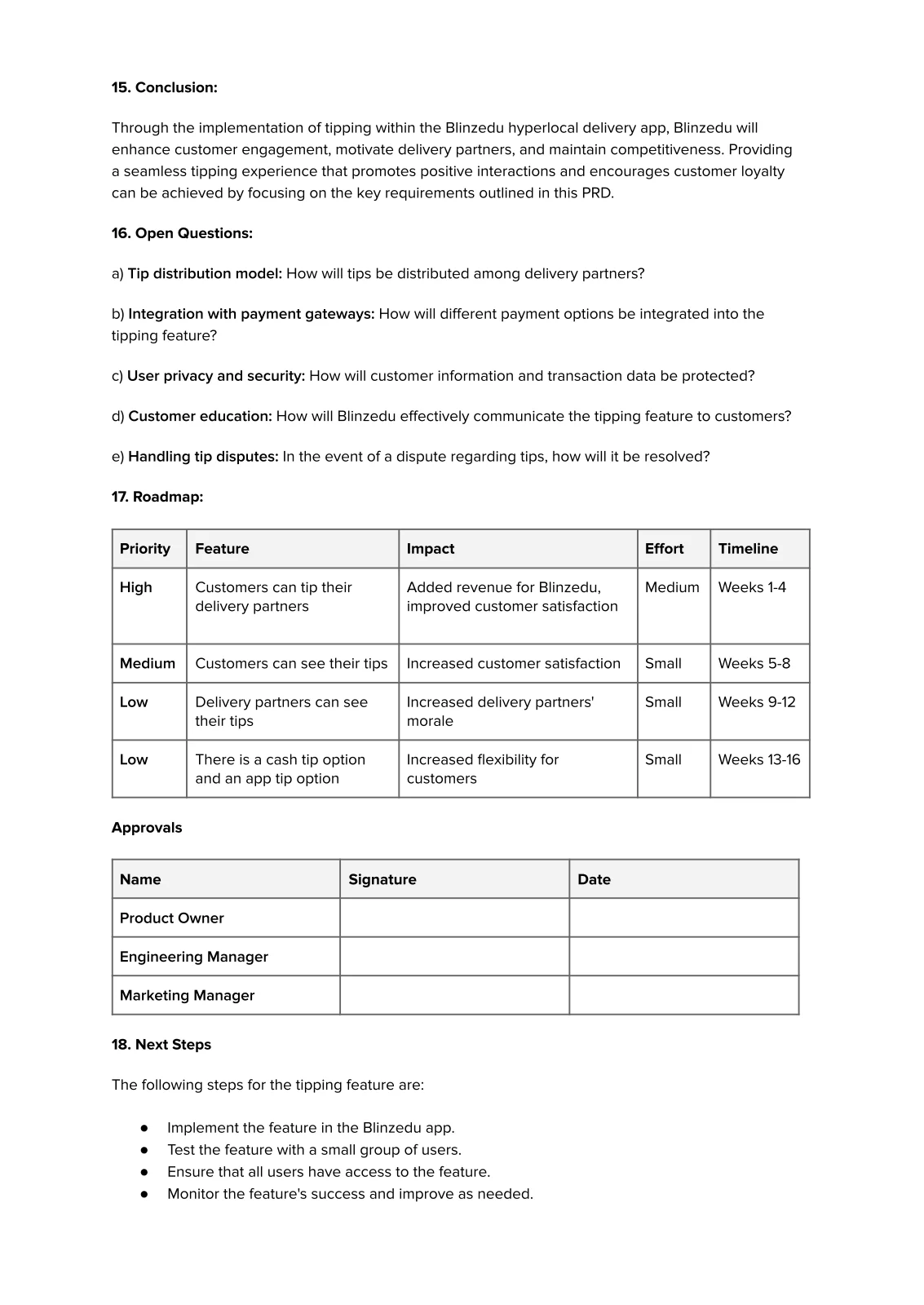
Roadmap
Sixteen weeks, four releases
The customer-facing half ships first, so we find out whether anyone tips before anyone builds the screens that report on tipping.
High · Weeks 1–4
Customers can tip their delivery partners
Added revenue for Blinzedu, improved customer satisfaction. Medium effort.
Medium · Weeks 5–8
Customers can see their tips
Increased customer satisfaction. Small effort.
Low · Weeks 9–12
Delivery partners can see their tips
Increased partner morale. Small effort.
Low · Weeks 13–16
Cash tip option alongside the in-app option
Increased flexibility for customers. Small effort.
Open questions
What the PRD deliberately does not answer
Five decisions belong to legal, payments and ops rather than to this document, so they are written down as open instead of guessed at. The PRD then goes to the product owner, engineering manager and marketing manager for sign-off.
- Tip distribution model. How are tips split among delivery partners?
- Payment gateways. How does each payment option integrate with the tipping flow?
- Privacy and security. How are customer information and transaction data protected?
- Customer education. How does Blinzedu communicate the feature at launch?
- Disputes. How is a disputed tip resolved?