By the numbers
Market snapshot
₹4,923 Cr
Blinkit gross order value (GOV), Q1 FY25 (2.3×)
₹43 Cr
Blinkit's first profitable quarter
$3B
Zepto annualised gross sales
10 min
Zepto delivery promise
Blinkit turned profitable in Q1 FY25 and leads on both share and average order value. Zepto is still buying scale with speed while it works on the economics underneath.
Revenue
Where the money comes from
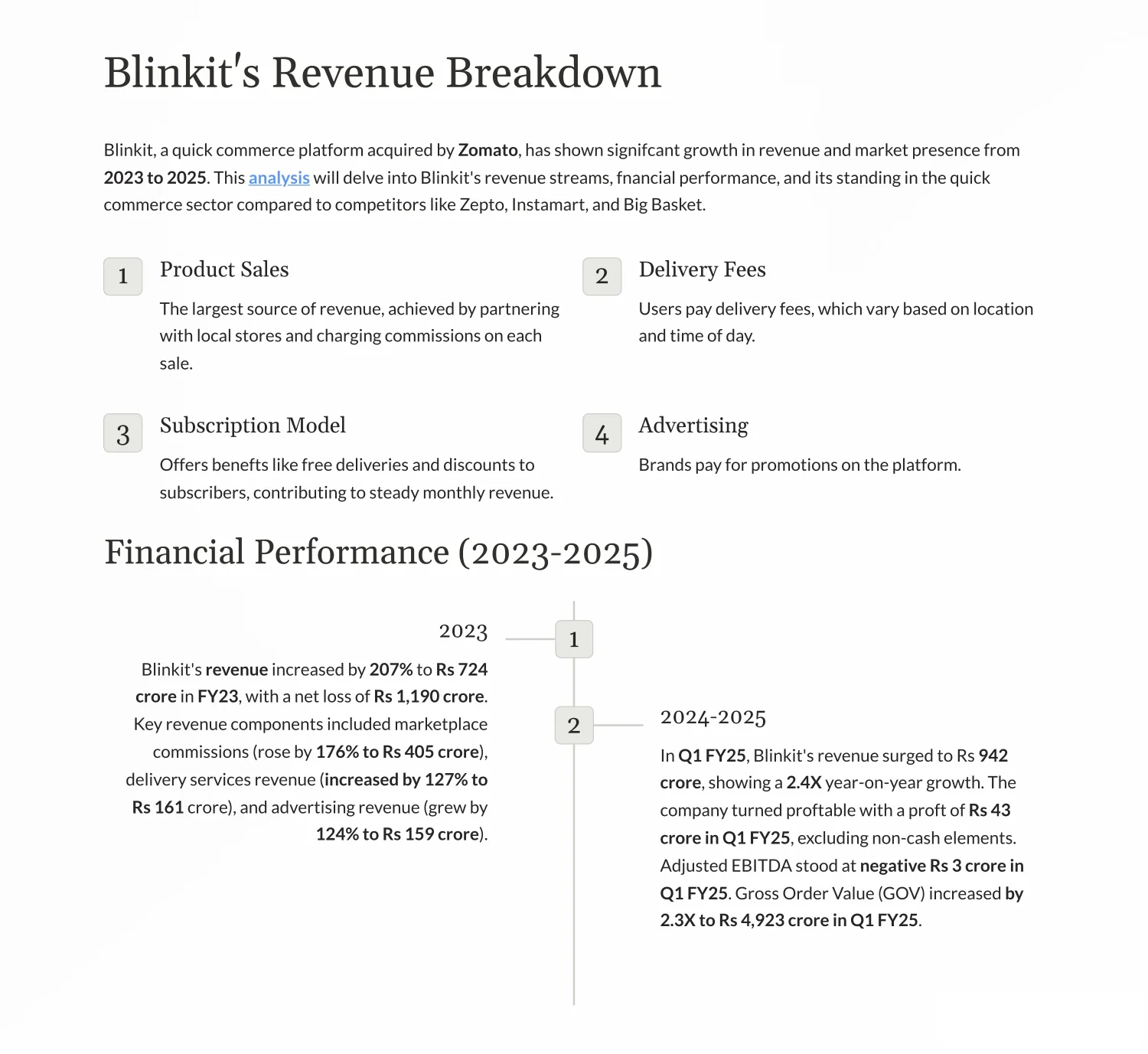
Commission on product sales carries the business. Delivery fees, subscriptions and advertising decide whether it turns a profit.
- Product sales: The largest source. Blinkit partners with local stores and charges a commission on each sale.
- Delivery fees: Paid by the user, varying with location and time of day.
- Subscriptions: Free delivery and discounts in exchange for steady monthly revenue.
- Advertising: Brands paying for promotion on the platform.
Two years apart
FY23
Revenue up 207% to ₹724 Cr against a net loss of ₹1,190 Cr. Marketplace commissions rose 176% to ₹405 Cr, delivery revenue 127% to ₹161 Cr, advertising 124% to ₹159 Cr.
Q1 FY25
Revenue of ₹942 Cr, up 2.4× year on year, with a ₹43 Cr profit, excluding non-cash items, and adjusted EBITDA of negative ₹3 Cr. GOV grew 2.3× to ₹4,923 Cr.
By Q1 FY25, revenue was up 2.4× year on year. The move from a ₹1,190 Cr loss to a profitable quarter is much larger, and it is the one worth reading: what it costs to serve an order matters more than how many orders there are.
The field
Who else is in the market
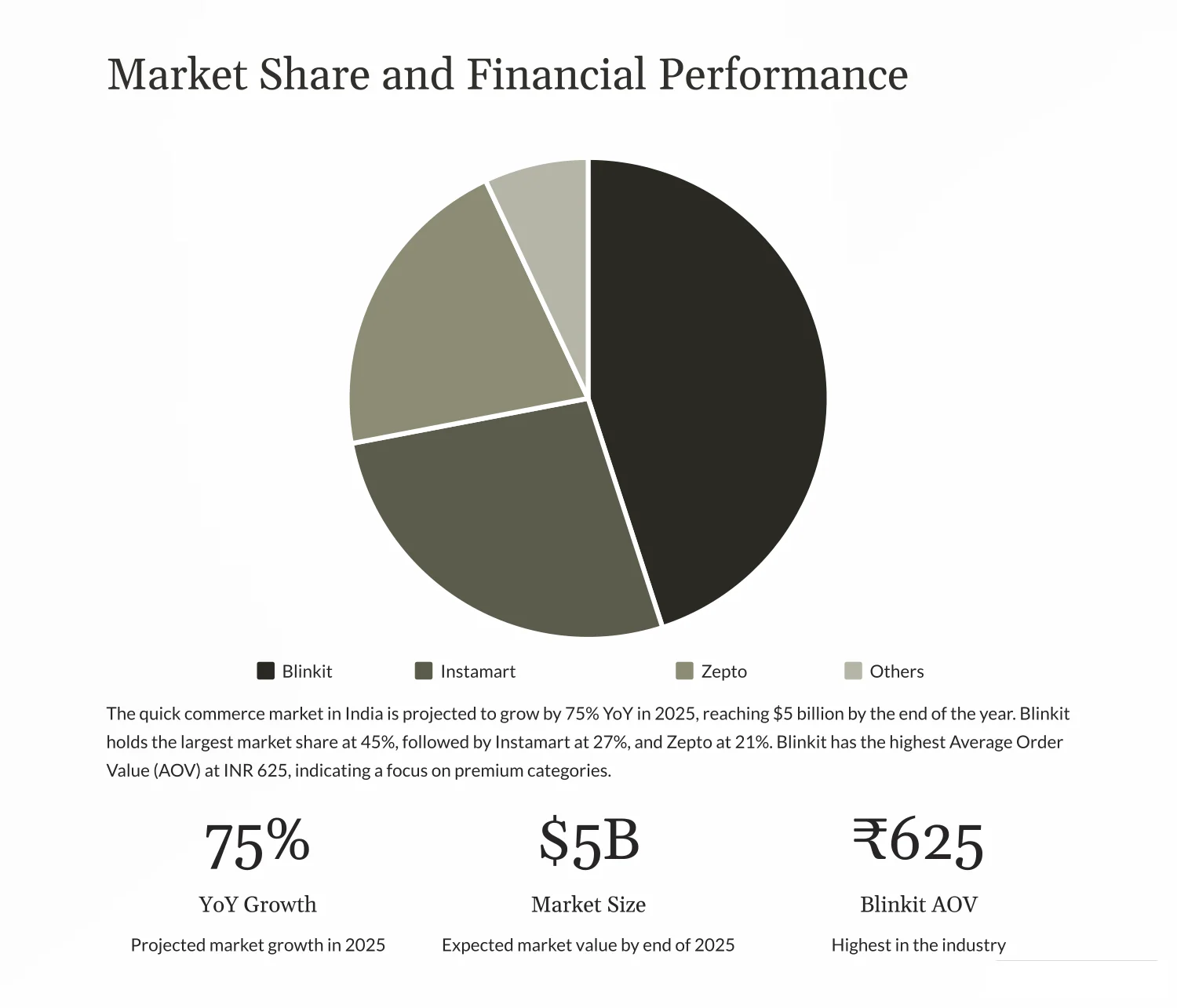
Quick commerce in India is projected to grow 75% year on year in 2025, reaching $5B. Blinkit holds the largest share and the highest average order value, which suggests its baskets lean premium.
₹625
Blinkit AOV, highest in the industry
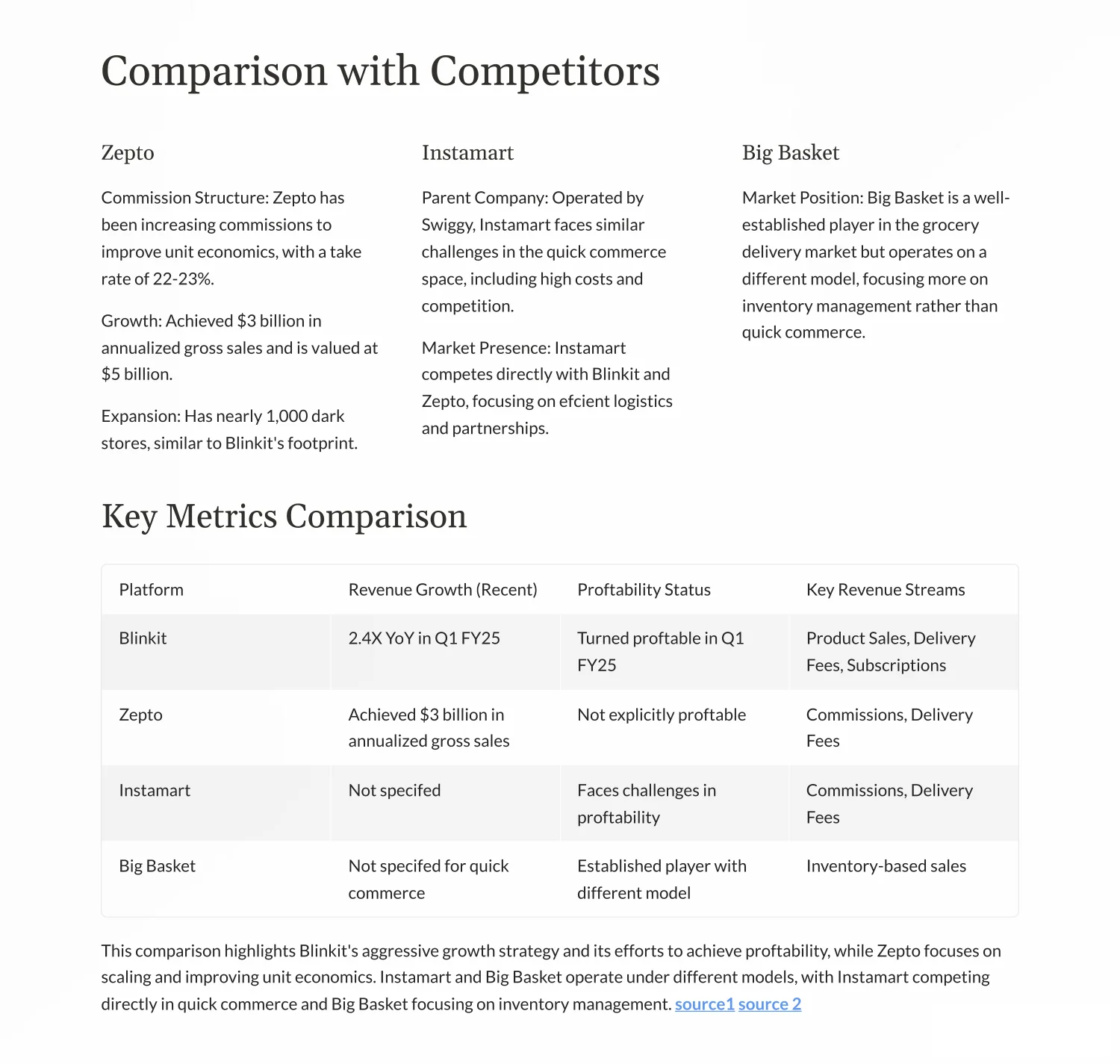
- Zepto: $3B in annualised gross sales at a $5B valuation, close to 1,000 dark stores, and commissions pushed to a 22–23% take rate to fix unit economics.
- Swiggy Instamart: Competing head-on with the same cost and competition problems, leaning on efficient logistics and partnerships.
- BigBasket: Well established in grocery delivery, but on an inventory-led model rather than quick commerce.
Logistics
How each one delivers
Both promise ten minutes. They pay for it in different ways.
Blinkit: breadth
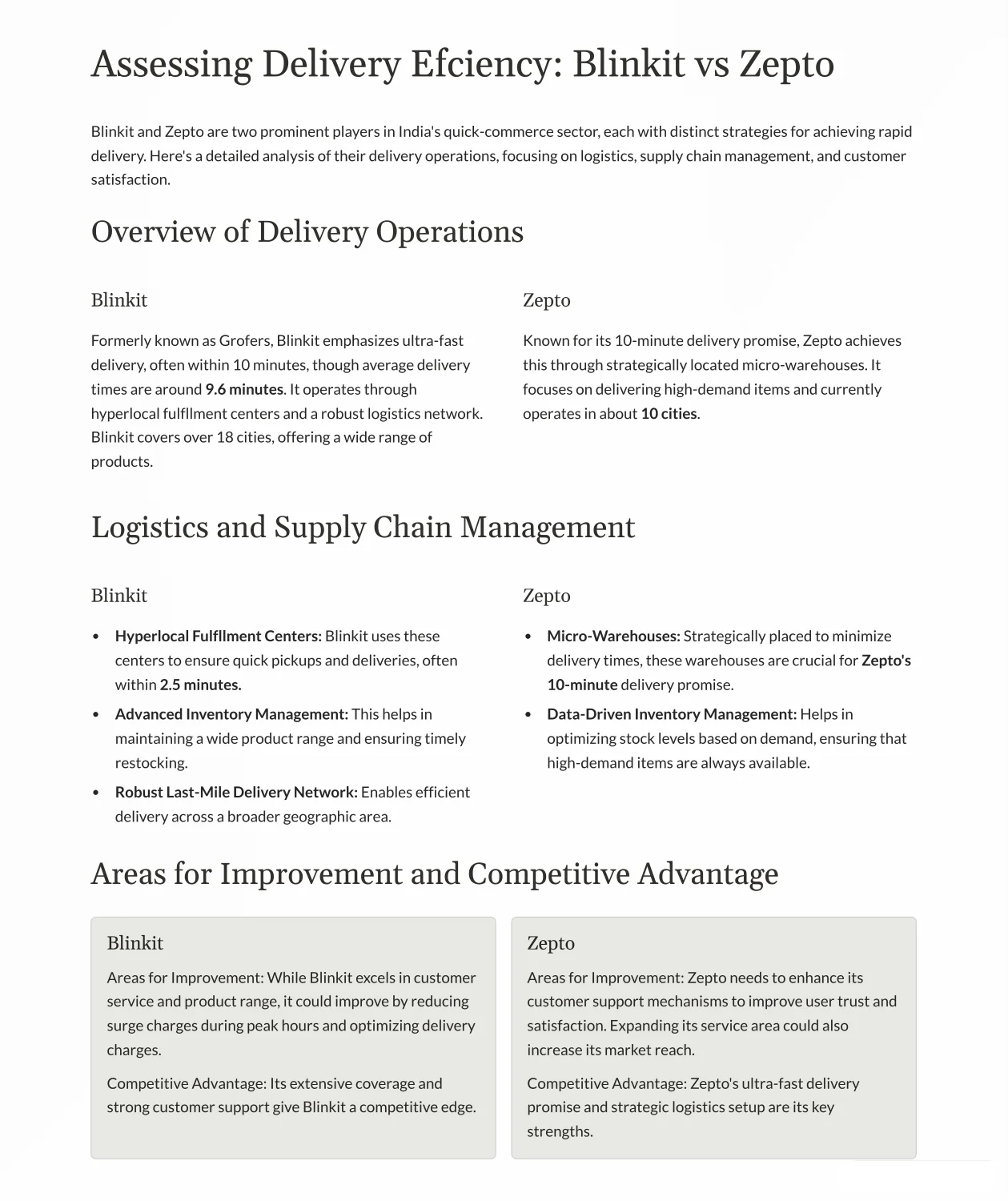
Hyperlocal fulfilment centres across 18+ cities, picking an order in about 2.5 minutes and averaging 9.6 minutes door to door. The last-mile network covers more ground than a ten-minute promise needs, which adds cost.
To fix: surge charges at peak, and the delivery-fee structure.
Zepto: depth
Micro-warehouses placed to shorten the last mile in roughly 10 cities. Stock levels follow demand, so fast-moving items stay available.
To fix: customer support, and the size of the service area.
Head to head
How they differ
Positioning
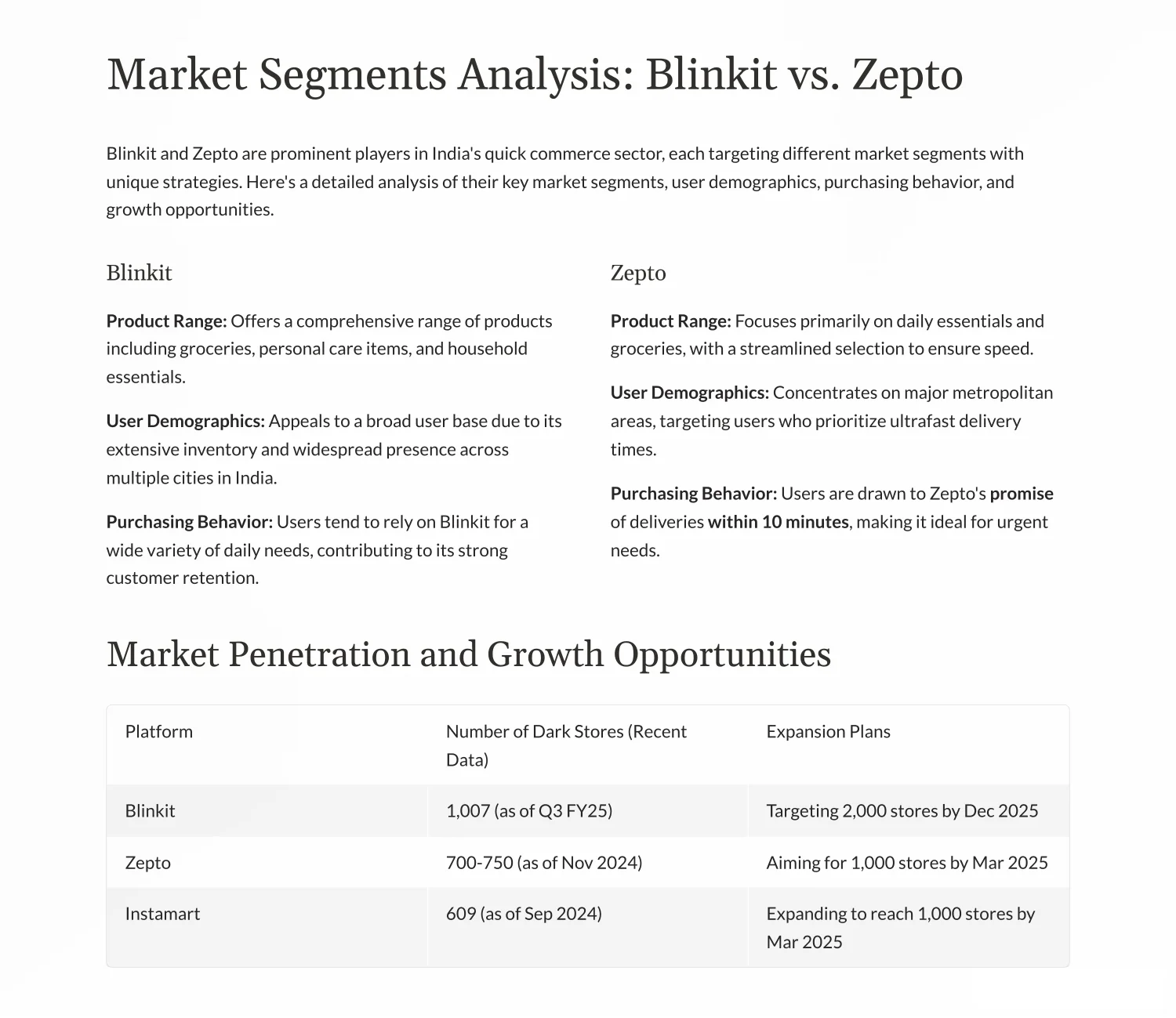
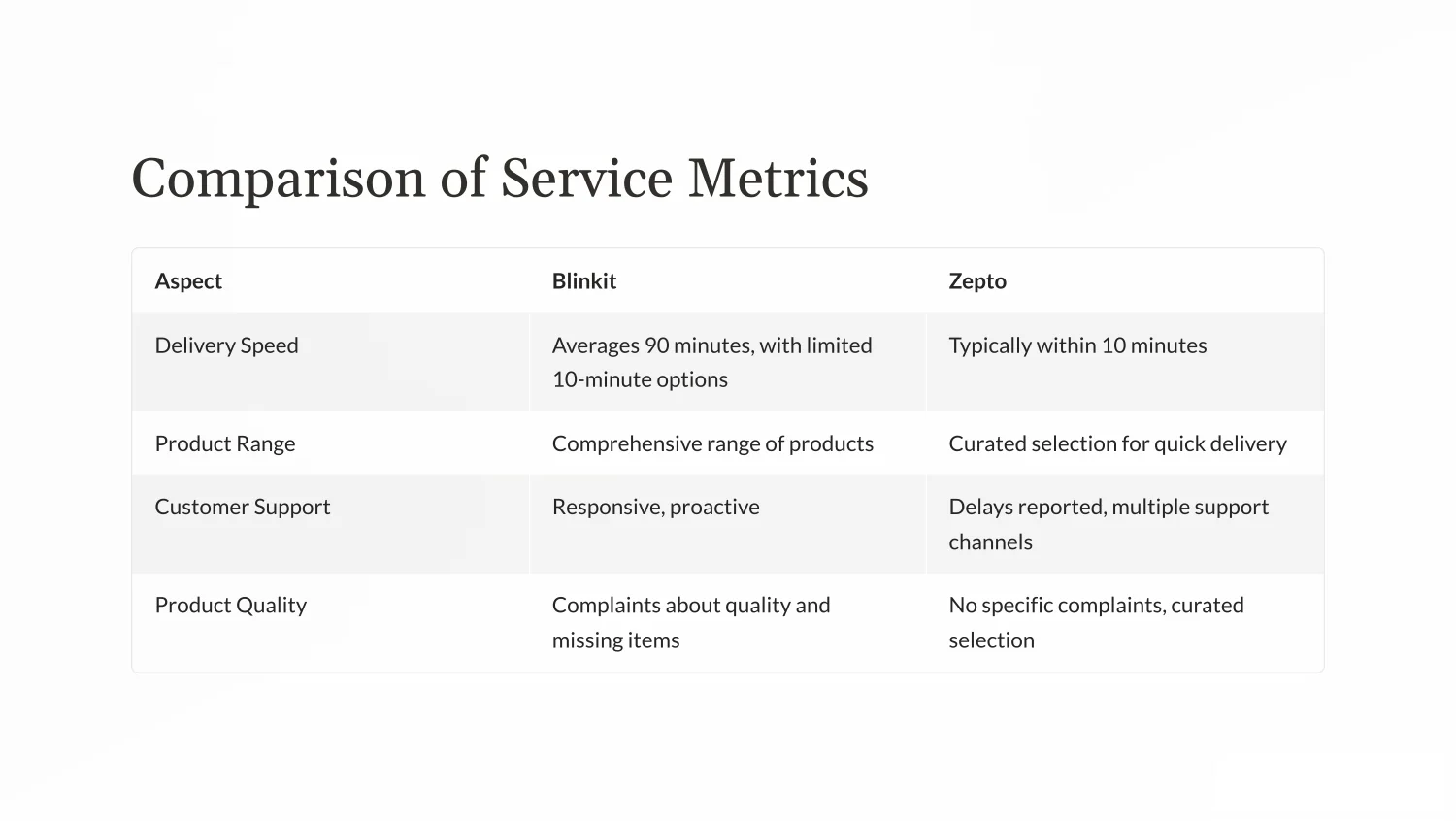
Blinkit: Wide product range, broad city coverage
Zepto: Ultra-fast daily essentials, curated range
Delivery
Blinkit: About 9.6 min on average, across 18+ cities
Zepto: A 10-minute promise, across roughly 10 cities
Fulfilment
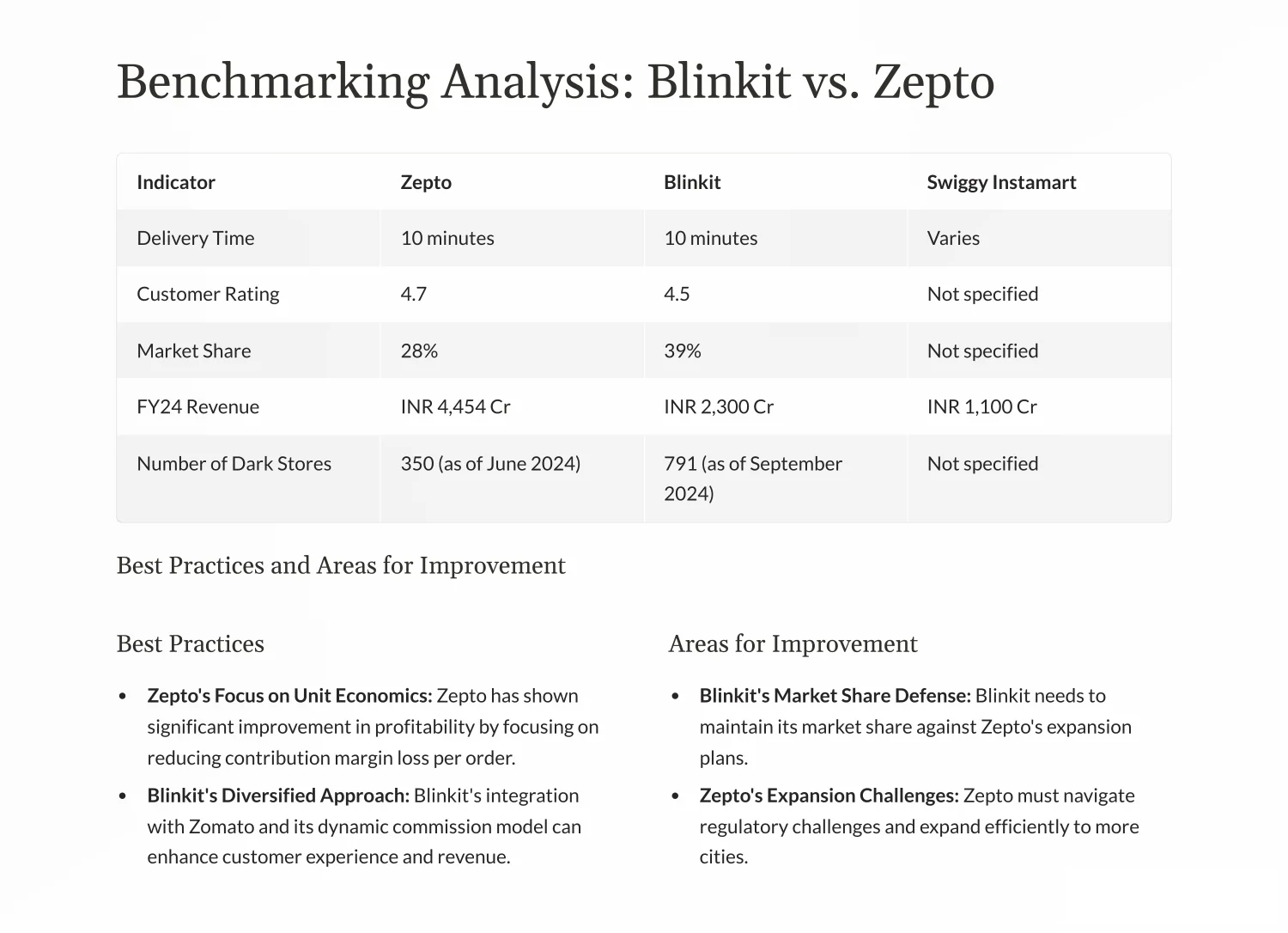
Blinkit: Hyperlocal fulfilment centres, 526 stores, going to 1,000 by end FY25
Zepto: Micro-warehouses placed to shorten the last mile, close to 1,000 already
Backing
Blinkit: Zomato's network and infrastructure
Zepto: Independent, focused on unit economics
Pricing
Blinkit: Cost-based, variable commissions
Zepto: Aggressive dynamic pricing, with the take rate pushed to 22–23%
Edge
Blinkit: Coverage, range, strong support
Zepto: Speed and logistics efficiency
SWOT
Strengths and watch-outs
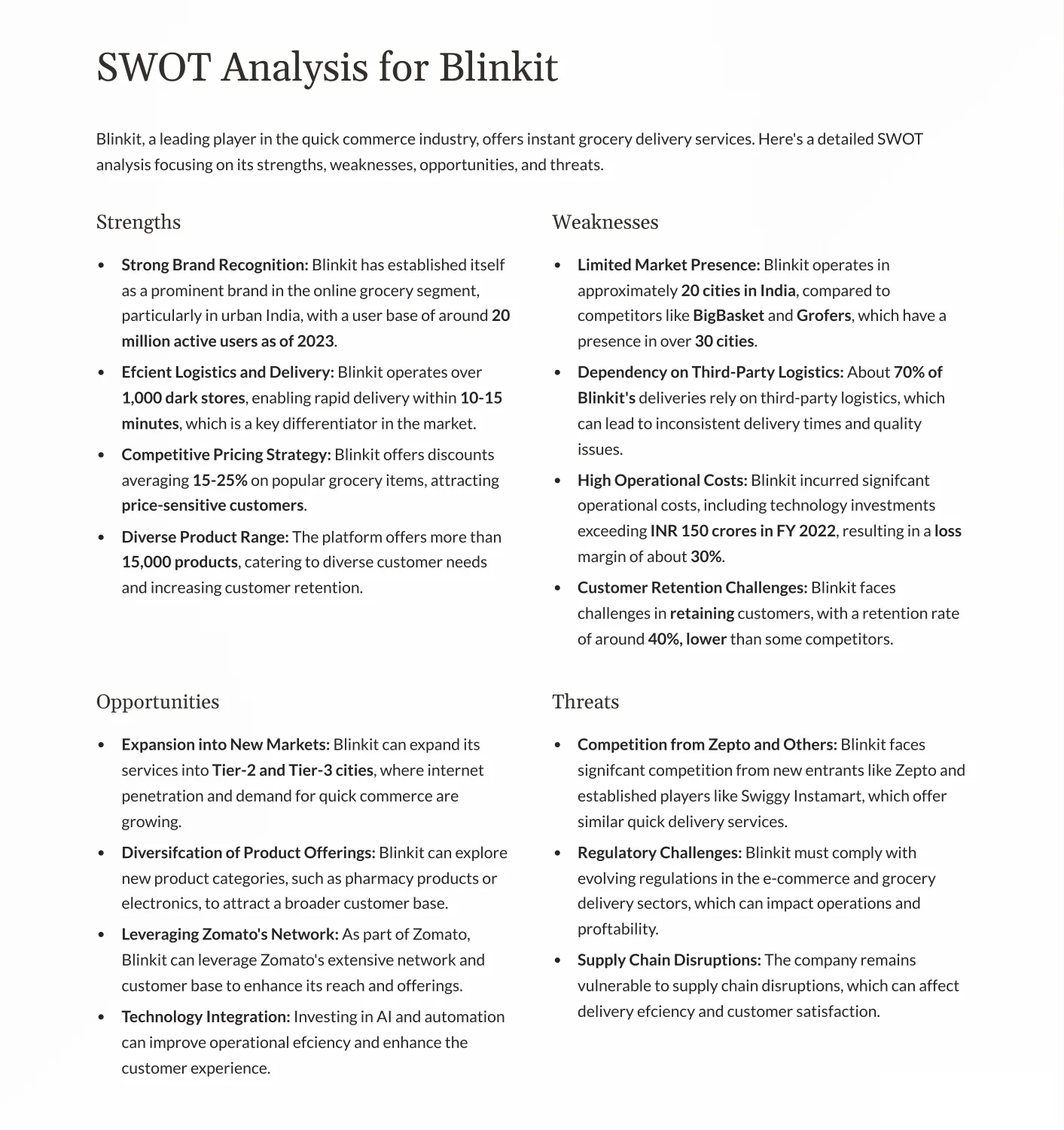
Blinkit: strengths
Around 20M active users, dark stores averaging 9.6 minutes, 15,000+ products, and discounts of 15% to 25% on popular grocery lines.
Blinkit: watch-outs
18+ cities against 30+ for BigBasket, with 70% of deliveries on third-party logistics. In FY22, technology spend passed ₹150 Cr against a loss margin near 30%, and retention sits around 40%.
Zepto: strengths
A 10-minute promise held up by micro-warehouses, demand-driven inventory and a hard focus on unit economics.
Zepto: watch-outs
Intense competition, thinner city coverage, and customer support that has not kept pace with the delivery promise.
Growth
Where each goes next
- Blinkit, on coverage: 526 stores to 1,000 by end FY25, concentrated on Delhi NCR, Bengaluru, Mumbai and Hyderabad, with tier-2 and tier-3 cities as the layer after that.
- Blinkit, on basket size: categories quick commerce does not usually carry, such as electronics and large appliances, plus brand tie-ups like Etude in beauty retail. Both aim at the size of each order rather than the number of orders, which is the lever that moves unit economics.
- Zepto: defend the speed advantage, sharpen the economics per order, and expand into more cities while navigating regulation.
- Both: AI-driven route optimisation, demand forecasting and inventory tooling to protect the sub-10-minute promise.